
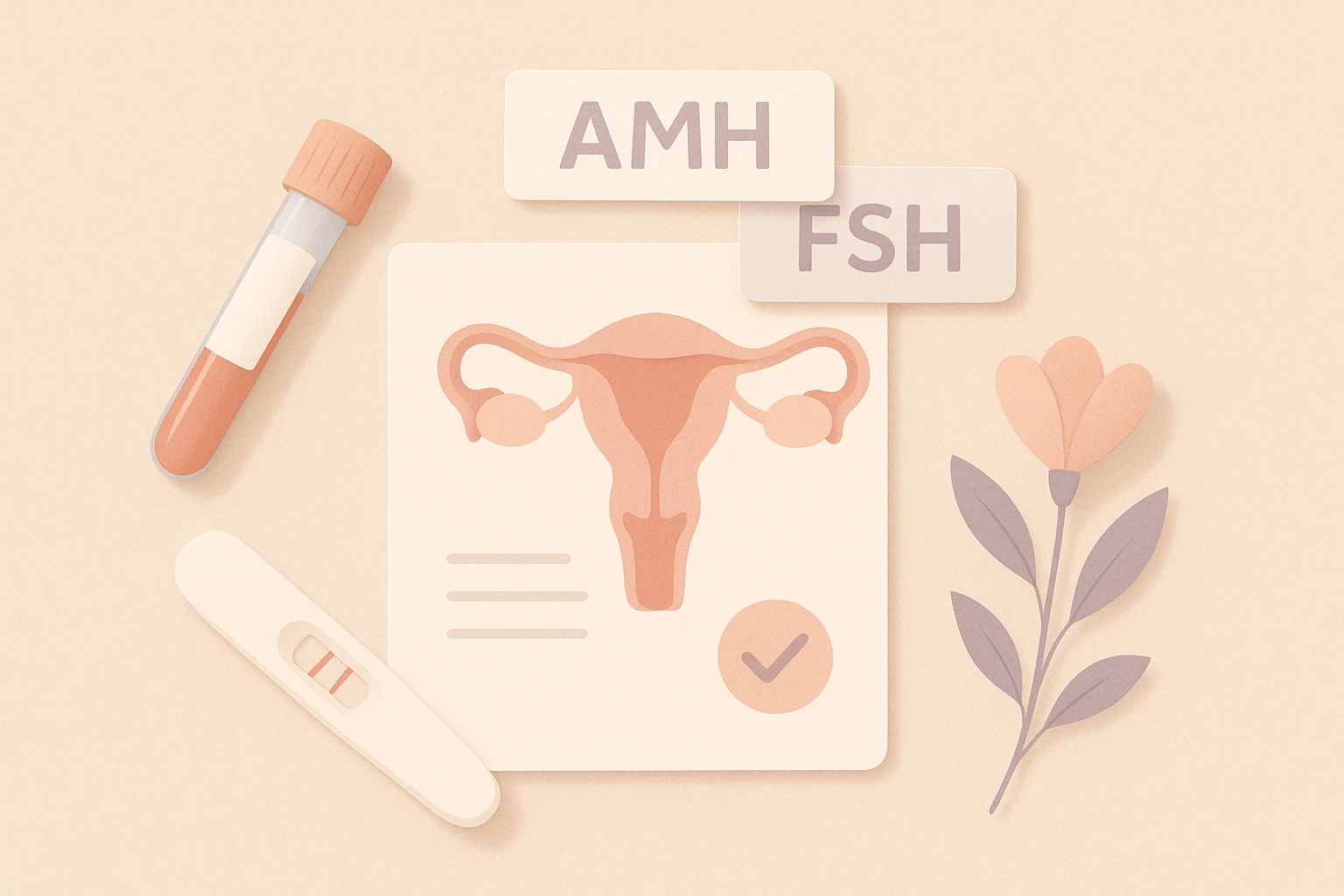


When you begin the journey of fertility testing, one of the first steps your doctor will recommend is a blood test to measure key hormones like Anti-Müllerian Hormone (AMH) and Follicle-Stimulating Hormone (FSH). These tests provide a snapshot of your ovarian reserve—the number and quality of eggs remaining in your ovaries—and help physicians understand how well your reproductive system is functioning. While the results can feel overwhelming at first, they are not simply "good" or "bad"; they are valuable clues that your care team uses to personalize your fertility plan, whether you are trying to conceive naturally, considering egg freezing, or exploring assisted reproductive technologies like IVF.
For women using a WP Ultimate Ovulation & Pregnancy Calculator to track their cycles, understanding these lab results adds a critical layer of insight into overall reproductive health. This comprehensive guide will walk you through what AMH and FSH actually mean, how to interpret your lab results, and what appropriate next steps might look like based on your unique numbers.
AMH and FSH are two of the most important hormones measured during initial fertility testing. Physicians generally start with these two hormone measurements to determine your current ovarian reserve, as they work together to give the greatest insight into your reproductive potential. While they are distinct markers, their relationship often provides a more complete picture than either one alone.
AMH is a hormone produced by the small follicles in a woman's ovaries. Because AMH levels directly correlate with the number of these developing follicles, it is considered the most sensitive and specific measure of ovarian reserve available today. Think of AMH as your "ovarian reserve meter"—it tells you how much egg supply you have left, but importantly, it does not measure egg quality.
According to the RMA Network, higher AMH values (typically greater than 1 ng/mL) usually signify a woman has a normal ovarian reserve. Conversely, lower numbers (less than 1 ng/mL) may indicate diminished ovarian reserve (DOR), meaning fewer eggs are available. Elevated AMH levels, often above 3.0 ng/mL, are frequently seen in women with PCOS, which can suggest a higher egg count but may also present challenges with ovulation regularity.
The general ranges for AMH levels are:
It is also important to note that AMH levels naturally decline with age. For example, a 25-year-old typically has an AMH level around 3.0 ng/mL, while a 40-year-old might average around 1.0 ng/mL. This decline is a normal part of the aging process and does not necessarily mean you cannot conceive, but it does help set realistic expectations for family planning or fertility treatments like IVF.
FSH is produced by the pituitary gland in your brain and plays a crucial role in stimulating the ovaries to develop follicles (eggs). Unlike AMH, which is produced by the ovaries, FSH is a signal sent to the ovaries. It acts as a communication line between your brain and your reproductive system.
When your ovarian reserve is healthy, your ovaries respond efficiently to FSH, and the pituitary gland does not need to produce excessive amounts of the hormone. However, when the ovarian reserve is diminished (fewer eggs remaining), the body may need to send a stronger signal to stimulate the ovaries. This results in higher FSH levels. Therefore, PNW Fertility explains that high levels of FSH can indicate diminished ovarian reserve.
Generally, physicians want FSH to be at the low end of normal. A Day 3 FSH level below 10 IU/mL is often cited as a typical normal baseline, while levels below 6 IU/mL are considered optimal. Levels above 10-15 IU/mL may suggest a declining ovarian reserve, and levels significantly higher than 20 IU/mL can indicate a more advanced decline.
The normal range for FSH is typically considered:
One of the most critical aspects of interpreting fertility lab results is understanding when the blood test was performed. Fertility testing is not a one-time event; it involves bloodwork at specific points in your menstrual cycle to capture different hormonal snapshots. The timing of your test directly impacts what your results mean.
Day 3 labs are drawn on the third day of your menstrual cycle (the first day of full bleeding is Day 1). These tests are the gold standard for assessing your ovarian reserve and baseline brain-ovary communication. The hormone panel typically includes:
Day 3 labs tell you whether your ovarian reserve appears normal for your age, whether your brain and ovaries are communicating properly, and if there are signs of conditions like PCOS or early ovarian decline. As Ubie Health notes, Day 3 labs check egg supply and baseline hormones, providing a foundation for your fertility care plan.
While Day 3 labs focus on egg supply, Day 21 labs (or more accurately, 7 days after ovulation) focus on whether you are actually releasing an egg. This test measures progesterone, a hormone that rises after ovulation to prepare the uterus for implantation.
If your progesterone level is strong (typically 10 ng/mL or higher, though some experts suggest 15 ng/mL or higher is ideal for better outcomes), it confirms that you have ovulated and that your progesterone is strong enough to support pregnancy. If progesterone is low, it may indicate that you did not ovulate, or that your ovulation is weak, which can make it difficult to conceive.
Day 21 labs confirm ovulation and progesterone strength. Both Day 3 and Day 21 labs are essential for a full picture of your reproductive health. Abnormal results do not automatically mean you cannot get pregnant; lifestyle modifications and treatments can often optimize the chances of conceiving.
Understanding your fertility lab results is not about looking for a single "perfect" number. Instead, it is about looking at the combination of your AMH, FSH, and other hormone levels to understand the story of your reproductive health. As Advanced Fertility explains, most fertility results are not "good" or "bad"; they are clues your care team uses to understand what might be affecting conception.
Here are general guidelines for what is considered "normal" for female fertility bloodwork, based on data from multiple fertility centers:
| Hormone | General Normal Range | What It Indicates |
|---|---|---|
| AMH | 1.0 ng/mL – 3.0 ng/mL | Ovarian reserve (egg quantity) |
| FSH (Day 3) | 7 mIU/mL – 21.5 mIU/mL | Brain-ovary communication (higher = lower reserve) |
| Estradiol (Day 3) | 10 pg/mL – 300 pg/mL | Baseline hormone balance (optimal: 30-50 pg/mL) |
| Progesterone (Day 21) | 10 ng/mL or higher | Confirms ovulation (optimal: 15 ng/mL+) |
It is crucial to remember that these ranges are general guidelines. Your age, cycle timing, and specific symptoms must all be considered when interpreting results. An AMH level of 0.8 ng/mL might be normal for a 42-year-old but concerning for a 28-year-old. Similarly, a high FSH level might be a sign of diminished reserve, but it could also be temporary due to stress or other factors.
According to the ASRM (American Society for Reproductive Medicine), AMH is a more sensitive measure of ovarian reserve than FSH and tends to decline before FSH rises. For this reason, AMH has largely replaced basal FSH as the primary test for ovarian reserve in many clinics. However, the committee also emphasizes that markers of ovarian reserve do not predict the likelihood of conceiving without treatment, nor do they offer clinically meaningful improvements over established pregnancy prediction models. Extremely low AMH values should not be used to refuse treatment in IVF.
Let's look at a few real-world scenarios to illustrate how lab results are interpreted and what next steps might look like.
Sarah, 28, had been trying to conceive for 6 months. Her AMH was 0.6 ng/mL (low), and her Day 3 FSH was 12 IU/mL (elevated).
At first, Sarah was terrified, thinking she was "too old" or had a serious problem. However, her doctor explained that while her numbers indicated diminished ovarian reserve, it did not mean she couldn't get pregnant. Sarah's age was still a strong factor, as egg quality is generally better in younger women. Her doctor recommended a more aggressive approach, such as starting with ovulation induction or considering IVF sooner than she might have otherwise. With a clear plan, Sarah was able to manage her anxiety and move forward with her fertility journey.
Jessica, 32, had irregular periods and an AMH of 4.5 ng/mL (high). Her FSH was 6 IU/mL (normal).
Jessica's high AMH suggested a large number of follicles, which is often a sign of PCOS. While she had many eggs, her irregular periods indicated she might not be ovulating regularly. Her doctor diagnosed her with PCOS and recommended lifestyle changes (like diet and exercise) to help regulate her cycles, along with medication to induce ovulation. Jessica's high AMH was actually a positive sign for her response to fertility treatments, as she had a large egg supply to work with.
Emily, 40, had been trying for 12 months. Her AMH was 1.2 ng/mL (normal for her age), and her FSH was 9 IU/mL (good).
Emily's lab results were reassuring, showing that her ovarian reserve was still intact. However, her doctor noted that while her egg quantity was good, her egg quality might be declining due to age. Emily's doctor recommended a thorough evaluation of her partner's sperm health and possibly a genetic screening test. With a normal reserve, Emily was able to pursue IVF with a good chance of success, though she was counseled on the potential for lower success rates compared to younger women.
If your fertility lab results show abnormal levels, it is important to remember that this does not mean you cannot get pregnant. Many women with low AMH, high FSH, or other abnormal results have successfully conceived with the help of medical treatment. The key is to work with a fertility specialist who can interpret your results in the context of your overall health and create a personalized plan.
Common next steps might include:
As SingleCare notes, abnormal fertility lab results do not preclude the possibility of pregnancy. With the right treatment, such as IUI, IVF, or GIFT, you can optimize your chances of conceiving.
While lab results provide a snapshot of your reproductive health, tracking your cycles daily can offer valuable insights into your overall fertility. Tools like the WP Ultimate Ovulation & Pregnancy Calculator can help you monitor your menstrual cycle, identify ovulation patterns, and predict your most fertile days. By combining your lab results with daily tracking, you and your doctor can create a more comprehensive and effective fertility plan.
For women who are using a WordPress fertility plugin to manage their pregnancy journey, understanding lab results is essential for making informed decisions about their health. Whether you are just starting your journey or have been trying for months, having a clear understanding of your AMH and FSH levels can help you feel more confident and prepared for the next steps.
Your fertility lab results, including AMH and FSH, are not a final verdict on your ability to conceive. They are simply a starting point that provides valuable information about your ovarian reserve and reproductive health. By working with a skilled fertility specialist, interpreting your results in the context of your age and overall health, and taking proactive steps to improve your fertility, you can move forward with confidence and hope.
Remember that every woman's journey is unique, and there is no single "right" number that defines your fertility. Whether your results are normal, high, or low, there are always options and treatments available to help you achieve your dream of pregnancy. If you have questions about your lab results or need guidance on your next steps, don't hesitate to reach out to your care team. And for more resources on fertility tracking and pregnancy management, explore the features of the WP Ultimate Ovulation & Pregnancy Calculator.
If you need to speak with a specialist or have further questions, please Contact Us today. We are here to support you every step of your journey.











